Bible people · Start with this story
מֹשֶׁה · Prophet, liberator, and mediator of Torah
Moses
The man who argued he could not speak, then stood before a king
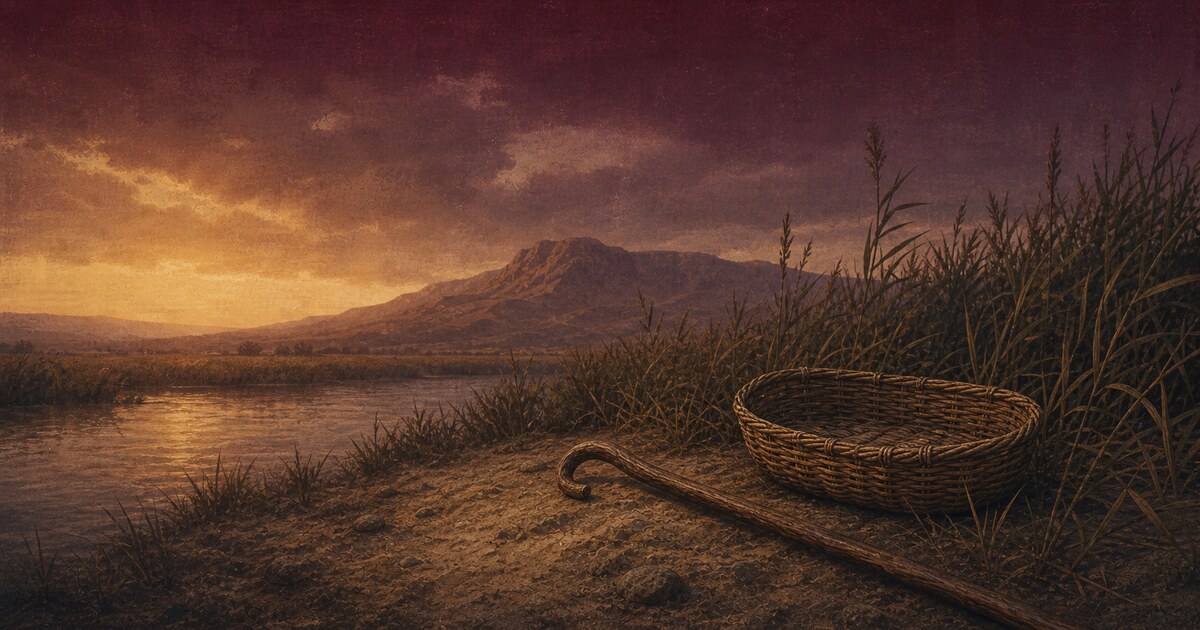
Moses’ story begins under Pharaoh’s order to kill Hebrew boys, with a basket among the reeds of the Nile. The child grows up in the royal household, flees after killing a man, and meets God at the burning bush with objection after objection. The liberator begins as a survivor, a fugitive, and a reluctant messenger.
How to read this study
No Bible background is needed. Read from top to bottom: each section tells what happened next, and the line at the end lists the passages or other sources used for that scene.
Words used on this page
New to the Bible? Start with these words.
These short definitions explain how each word is used in this article. You do not need to know them before you begin.
- Covenant
- A committed relationship established by promises and responsibilities.
- Prophet
- A person who delivers a message believed to come from God. A prophet is not simply someone who predicts the future.
- Torah / Law
- “Torah” can mean the first five books of the Bible or God’s instruction. “Law” is sometimes used as its translation.
- Pharaoh
- The title used for the ruler of ancient Egypt, rather than a personal name.
The Nile and Pharaoh’s house
A basket floats inside an order of death
Moses is born under Pharaoh’s command to kill Hebrew boys. When his mother can hide him no longer, she sets him among the reeds in a small basket.
Pharaoh’s daughter finds the child, and Moses’ sister arranges for his own mother to nurse him. Between the river of death and the royal household, he grows inside two worlds.
ReferencesExodus 1:8–2:10
Egypt and the wilderness of Midian
He kills an Egyptian and runs from Pharaoh
Moses sees an Egyptian beating a Hebrew and kills the attacker. He buries the body in sand, but the act becomes known.
Pharaoh tries to kill him, so Moses escapes to Midian. There he defends shepherds at a well, starts a family, and spends years far from the palace and the enslaved people he tried to defend.
ReferencesExodus 2:11–25
Horeb, the mountain of God
A burning bush sends the reluctant fugitive back
God calls Moses from a bush that burns without being consumed and tells him to return to Egypt. Moses asks what name he should give and what proof the people will believe.
He then says he is not a good speaker and asks God to send someone else. Aaron will help him speak, but Moses still has to turn toward the place he fled.
ReferencesExodus 3:1–4:17
Pharaoh’s court and Egypt
‘Let them go’ meets ‘No’ until a country breaks
Moses and Aaron demand Israel’s release. Pharaoh increases the labor, retreats under pressure, and hardens again.
Exodus speaks both of Pharaoh hardening his heart and of God hardening it. The final plague takes Egypt’s firstborn. The night of liberation is not a clean victory scene but a terrible collision of oppression, judgment, and death.
ReferencesExodus 5:1–12:36
The sea and the wilderness
They leave slavery; slavery’s fear comes with them
The sea stands ahead and Egypt’s army closes from behind. A path opens, Israel crosses, and the pursuers are swallowed by the water. A song erupts.
Three days later the complaints begin. Water, food, and danger make Egypt look attractive again. Leaving a place is faster than unlearning the fears formed there.
ReferencesExodus 14:1–17:7
Mount Sinai
He carries the tablets down and smashes them immediately
While Moses receives the covenant on the mountain, a golden calf rises below. He sees the camp and hurls the tablets down the slope.
He is furious and yet asks God to forgive the people, even at the cost of his own name. Moses carries the law and also pleads for people who have already broken it.
ReferencesExodus 19–20 · 24 · 32–34
Years in the wilderness
Leadership becomes a weight he cannot carry alone
Moses hears repeated complaints about food, water, danger, and the length of the journey. At one point he tells God that the load of the people is too heavy for him.
Helpers share the work, but anger still breaks through. At Meribah Moses strikes the rock instead of speaking to it as instructed, and he is told that he will not lead the people into the land.
ReferencesNumbers 11:1–30 · 12:1–16 · 20:1–13
The plains of Moab and Mount Nebo
He sees the destination and does not enter it
Moses prepares Joshua to lead and repeats the law for the generation that will cross the Jordan. His final speeches look backward at failure and forward to life in the land.
Moses sees the land from Nebo and dies, his grave unknown. His last scene belongs not to a hero who completes everything, but to a leader who must hand the work on.
ReferencesNumbers 27:12–23 · Deuteronomy 31:1–8 · 32:48–52 · 34:1–12